Stargazing in Koh Samui in August 2026
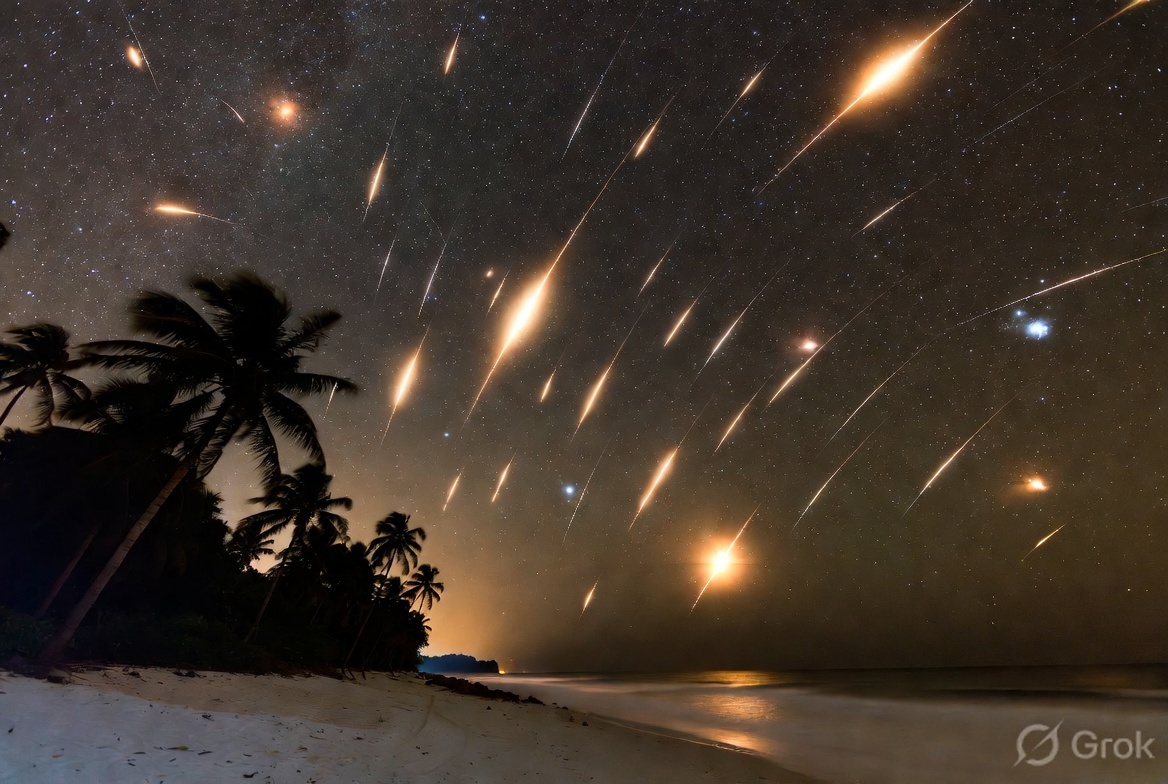
From Koh Samui (about 9.5°N, 100°E), August 2026 offers strong naked-eye views of the Perseid meteor shower under ideal dark skies, bright planets (especially Venus and Saturn), the Summer Triangle and southern Milky Way core, plus routine Moon phases and stars—weather permitting. No telescope is needed for any of these. The island’s low latitude favors southern sky objects; light pollution varies (better from beaches or quieter inland spots away from towns). Note that August falls in Thailand’s rainy/monsoon season, so clear nights are not guaranteed.
Perseid Meteor Shower (highlight of the month)
- Peak: nights of August 12–13, 2026 (predicted maximum around 14:53 UTC on the 13th). Active from mid-July into late August.
- Excellent conditions: New Moon on August 12 means essentially moonless dark skies.
- Expect dozens of meteors per hour (potentially 50–100 under truly dark skies), including bright fast ones that often leave persistent trains. They radiate from Perseus (northeast after midnight) but can appear anywhere.
- Best viewing: after midnight until dawn, lying back and looking generally upward/northeast. From ~9.5°N the radiant is lower than at higher northern latitudes but still fully usable; rates remain good. Early Perseids and leftover Southern Delta Aquariids/Alpha Capricornids may appear in early August. earthsky.org
Planets Visible from Koh Samui in August 2026
- Venus (Evening Star): Brilliant in the western sky after sunset throughout August. It reaches greatest eastern elongation around August 14–15 (about 46° from the Sun, magnitude roughly –4.3 to –4.4). It is the brightest “star-like” object after the Moon and remains easily visible even in modest twilight. A crescent Moon pairs with it around August 15–16. earthsky.org
- Saturn: Visible in the evening/morning sky (Pisces/Cetus region), rising earlier as the month progresses (around late evening early in the month, earlier by late August). Steady yellowish light, magnitude ~0.5–0.6; easy naked-eye target. Moon nearby early and late in the month.
- Mars: Morning sky (orange-ish), improving and brightening gradually.
- Mercury: Best in the morning sky early in the month (greatest western elongation around August 2); low but possible with a clear eastern horizon.
- Jupiter: Emerging into the morning sky mid-to-late month, still low and challenging early on; closer approaches or pairings with Mercury around the 15th.
- Around August 12 there is a morning planetary lineup (Jupiter, Mercury, Mars, Saturn, plus fainter Uranus/Neptune). Naked-eye standouts are mainly Mars and Saturn; Mercury and especially Jupiter are low in dawn twilight. starwalk.space
Moon and related
- New Moon: August 12 (dark skies for Perseids and Milky Way).
- First Quarter: around August 19–20.
- Full Moon: August 28 (Sturgeon Moon).
- Last Quarter: early August (around the 5–6).
- Crescent Moon pairings with Venus (mid-month) and other planets (early/late). No significant solar or lunar eclipse is visible from Thailand/SE Asia (the August 12 total solar eclipse is confined to parts of Europe/Atlantic/Arctic; the deep partial lunar eclipse of August 27–28 is not visible as the Moon is below the horizon). moongiant.com
Stars, constellations, and Milky Way
- Summer Triangle (Vega in Lyra, Deneb in Cygnus, Altair in Aquila) is high and prominent after dark.
- Southern sky is excellent: Scorpius (with red Antares) and Sagittarius (Teapot asterism) ride high. The bright core of the Milky Way is well placed in the south/southeast in the evening—especially around the New Moon window—appearing as a rich, hazy band under dark skies. This is one of the better times of year for the galactic center from tropical latitudes.
- Other bright stars and familiar patterns are readily visible on clear nights.
Other notes
- Comet 10P/Tempel reaches perihelion/closest approach around August 2–3 but is expected only around magnitude 8–10 (binocular/telescope object at best, not reliable naked-eye).
- No major unexpected naked-eye events (bright comets, etc.) are predicted as of available forecasts.
- Practical tips: Seek darker sites away from town lights; allow 20–30 minutes for dark adaptation; check local weather and sunrise/sunset (roughly 06:00–18:40 local time, UTC+7). Apps or planetarium software can refine exact positions/times for your exact spot.
Overall, the standout combination is the moonless Perseids plus Venus and the southern Milky Way. Clear evenings or pre-dawn hours will deliver the best views.
Also check out:

Australian travel blogger and aviation enthusiast based in Sydney, living a relaxed retired life filled with daily flat whites. Passionate about exploring The World's hidden gems TripAtrek travel blog is on a mission: To share these gems with you.