Astronomy from Ao Nang in December 2025
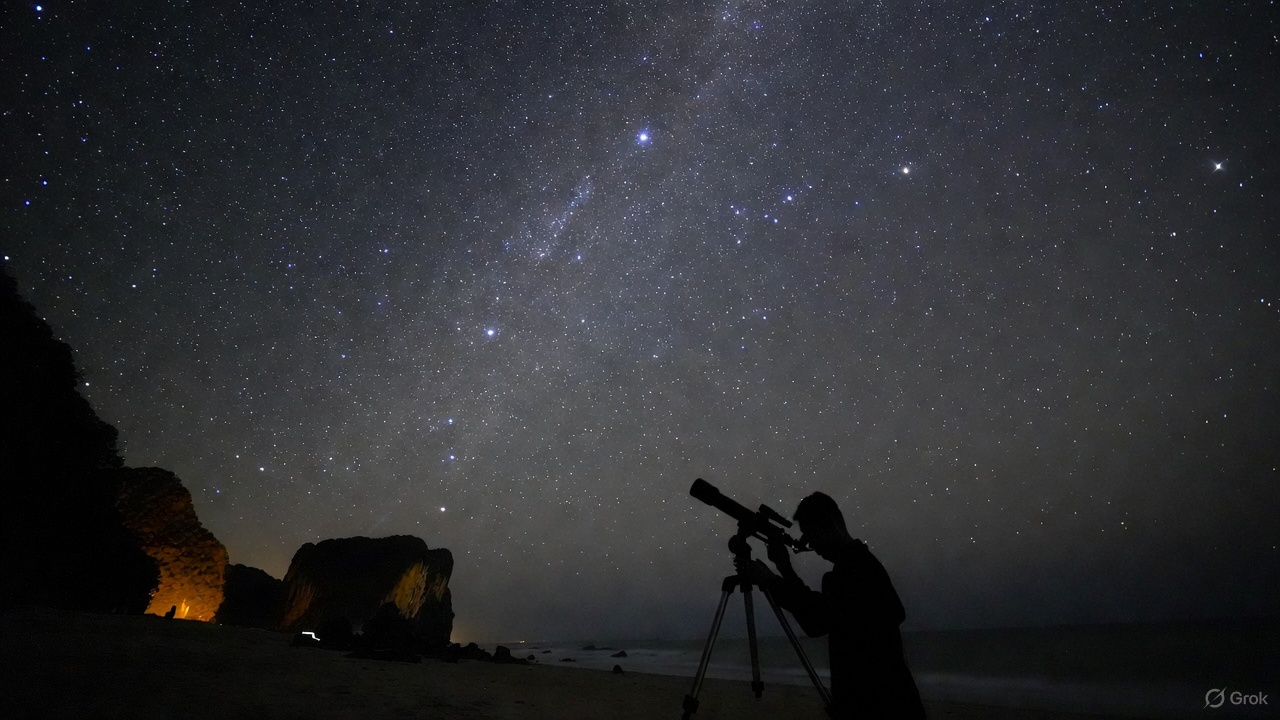
The next full moon after December is 3rd January 2026, making mid to late December the perfect time for star gazing in Ao Nang Krabi Thailand.
On December 21, 2025, in Ao Nang (Krabi, Thailand), moonlight will be very minimal—excellent conditions for stargazing or telescope viewing.
- Moon phase: Waxing Crescent (just 1–2 days after New Moon on Dec 20).
- Illumination: Only about 1–2 % lit (a thin silver sliver).
- Visibility: The Moon rises shortly after sunrise and sets shortly after sunset, so it’s low on the horizon during the day and barely visible at dusk. By full dark (around 7–8 PM), it’s already set or extremely low and faint.
In short: Almost no moonlight interference all night—near-perfect “dark sky” conditions (as good as it gets in coastal Krabi). You’ll have clear, moon-free viewing from astronomical twilight (~7:30 PM) until dawn.If you’re heading out with the telescope, December 21 will be one of the best nights of the month for deep-sky objects like Andromeda.
Planets Visible (Evening to Midnight)
Mercury — Too close to the Sun, not visible. Enjoy!
Jupiter — Super bright in the east after sunset, high overhead by midnight. In a telescope: see the four Galilean moons and cloud bands easily.
Saturn — Low in the west at dusk, sets by ~10–11 PM. Rings are still beautifully open—stunning in even a small scope.
Mars — Rising in the east around midnight, getting brighter nightly. Reddish and obvious; telescope shows the polar cap and dark markings.
Venus — Extremely bright in the morning sky before dawn (not evening).
Deep-Sky Highlights (Best After 9–10 PM in Darker Spots)
With your portable telescope (assuming 100–127 mm aperture) and low light pollution (e.g., Railay Beach far end, Hang Nak viewpoint, or northern Noppharat Thara Beach):
- Orion Nebula (M42) — The standout of the night. Rising in the east around 8–9 PM, it’s a glowing cloud of gas with the Trapezium stars visible—your “wow” target.
- Pleiades (M45) — High overhead all evening. A sparkling jewel box of stars, perfect for wide-field views.
- Hyades — Nearby open cluster forming the “V” of Taurus—big and bright.
- Andromeda Galaxy (M31) — Visible to the naked eye as a faint smudge on dark nights; in your telescope it appears as a bright oval core with extended halo—exactly what you wanted!
- Beehive Cluster (M44) — Lovely open cluster in Cancer, rising later.
- Southern treats (thanks to your low latitude): Omega Centauri (best globular cluster in the sky) and 47 Tucanae are up in the south—spectacular in a telescope.
Meteor Showers
The Ursids peak around December 21–22 (up to 10/hour max), radiating from near the Little Dipper. Rates are low, but you might catch a few bright ones in a moonless sky. Ao Nang’s coastal location means humidity can cause haze, so head to elevated spots like Hang Nak trail for the clearest views. Bundle up (December nights can dip to 22–24°C) and enjoy—one of the best telescope nights of the year in southern Thailand.
You’ll be able to see the same night sky in most places around Thailand, i’m just planning a voyage to Ao Nang. Best places to see it are on the remote islands like Koh Tao or Koh Kood with the least amount of lights. Even in a small town or village, get away from the town centre. Koh Kood has some lovely jetties away from your resort, perfect for a night watching the sky.
What are you most excited to see?
Best vantage points near Ao Nang (Krabi)
Here are the best vantage points near Ao Nang (Krabi) for stargazing with relatively clear skies and low light pollution in 2025. Ao Nang itself is moderately lit (Bortle 5–6), so you’ll need to head a bit out of town for decent views—expect the Milky Way on good nights, but not ultra-dark skies like northern Thailand. These spots are accessible by scooter/car (20–60 min drive) or boat, with elevation or distance reducing glare from town.Top Spots (Ranked by Darkness + Ease of Access)
- Tab Kak Hang Nak Nature Trail / Dragon Crest Viewpoint (Best Overall)
- ~30–45 min drive north of Ao Nang (near Nong Thale).
- Elevated 500m+ with panoramic open views—very low light pollution once you’re at the top.
- Clear nights often show the Milky Way; popular for sunset + stargazing combos.
- Tip: Hike up late afternoon (trail closes officially at 4–5 PM but many go after); bring a headlamp for descent.
- Railay Beach (West or Phra Nang side, away from resorts)
- 15-min longtail boat from Ao Nang (last boats ~6 PM, or stay overnight).
- Much darker than Ao Nang—few lights on the cliffs. Walk to the far ends or Phra Nang Cave area for minimal glow.
- Great for naked-eye stargazing; the limestone walls block town lights.
- Khao Ngon Nak Viewpoint (Dragon Crest alternate trail)
- Similar to Hang Nak but slightly different access—same area, often quieter at night.
- Noppharat Thara Beach (northern end, past the bridge)
- 10–15 min drive north of Ao Nang town.
- Long, open beach with very little development on the far end—dark enough for planets and brighter stars.
- Koh Poda or nearby islands (by private longtail at night)
- 25-min boat from Ao Nang. Hire a fisherman for an evening trip (many do bioluminescent plankton tours that double as stargazing).
- Zero light pollution on the beach—some of the darkest skies you’ll get without going inland.
Quick Tips for Testing Your Telescope in Ao Nang
- Best months: November–April (dry season, clearer skies).
- Avoid full-moon periods.
- Drive/scooter out after 9–10 PM when most lights dim.
- Use the LightPollutionMap.app – Ao Nang is orange zone; the spots above push into yellow/green.
If you want truly dark skies for Andromeda’s core, consider a day trip to Khao Sok National Park (2–3 hrs drive) or the hills around Krabi Town, but the above are the most practical from Ao Nang without overnighting far away.
Post coming soon – buying a travel telescope in Bangkok

Australian travel blogger and aviation enthusiast based in Sydney, living a relaxed retired life filled with daily flat whites. Passionate about exploring The World's hidden gems TripAtrek travel blog is on a mission: To share these gems with you.